

A response to Ranking Member Wyden’s Request for Information of July 30, 2026 — the plan misses 68 to 76 percent of the money that does not buy care, $382 billion a year, most of it hospital pricing.
August 4, 2026
This executive summary is available to all readers. Subscribe to access the full report, interactive exhibits, and AI analyst.
Senate Finance Committee Democrats have described, more honestly than any committee before them, how insurers profit by denying care — then proposed a plan that does not reach 68 to 76 percent of the problem, $382 billion a year, most of it hospital pricing. This submission, filed jointly by Brainworks Research and the Institute for New Economic Thinking in response to the Committee's 86-page Request for Information of July 30, 2026, grades the Committee's own proposals against three measurable tests and supplies the legislative text where the RFI asks only whether.
The diagnosis is right, and the Committee's own numbers convict. Denying care is how insurers make money, not bad administration. Insurers keep "nearly $1,000 per enrollee annually in overhead and profit"; the rule written to claw that back returned "approximately $200" — six pages apart, never compared. Nineteen percent of 2024 in-network claims were denied — 85 million, on care already agreed to — and a fraction of one percent were appealed. SOURCED.
But the proposals regulate insurers and nothing else, which is 24 to 32 percent of the money that does not buy care. Hospitals are the largest untouched piece — $306 billion ESTIMATED, paid 254 percent of Medicare for identical inpatient care — plus $76 billion of Medicare Advantage overpayment SOURCED. Across 86 pages, "facility fee," "provider consolidation," "market power," "monopoly" and "antitrust" appear zero times. How insurers behave decides how the dollars get fought over; what hospitals charge decides how many dollars there are.
Squeezing one part of a conglomerate moves the money to another part of the same conglomerate. The RFI concedes the principle itself: the Medical Loss Ratio rule "has created unintended incentives for insurers to expand into provider, PBM, and pharmacy markets." For 34 of the 71 proposals rated here we can name the specific place the money would move to. Hence four design principles — cover the whole company, cover the whole chain, keep rules enforceable, require disclosure before caps — and a falsifiable prediction: five years on, the premium share reaching care will be within ±2 points of where it started, while reported MLR rises and reported administrative costs fall.
All 71 proposals are rated one by one, each scored on the care-dollar ratio, effective access, and gameability — whether a rule can be relocated or relabelled. Every numeric value carries one of three labels: SOURCED (published third-party), ESTIMATED (our calculation), ANALYST (our judgement). No others. Comments close October 2, 2026.
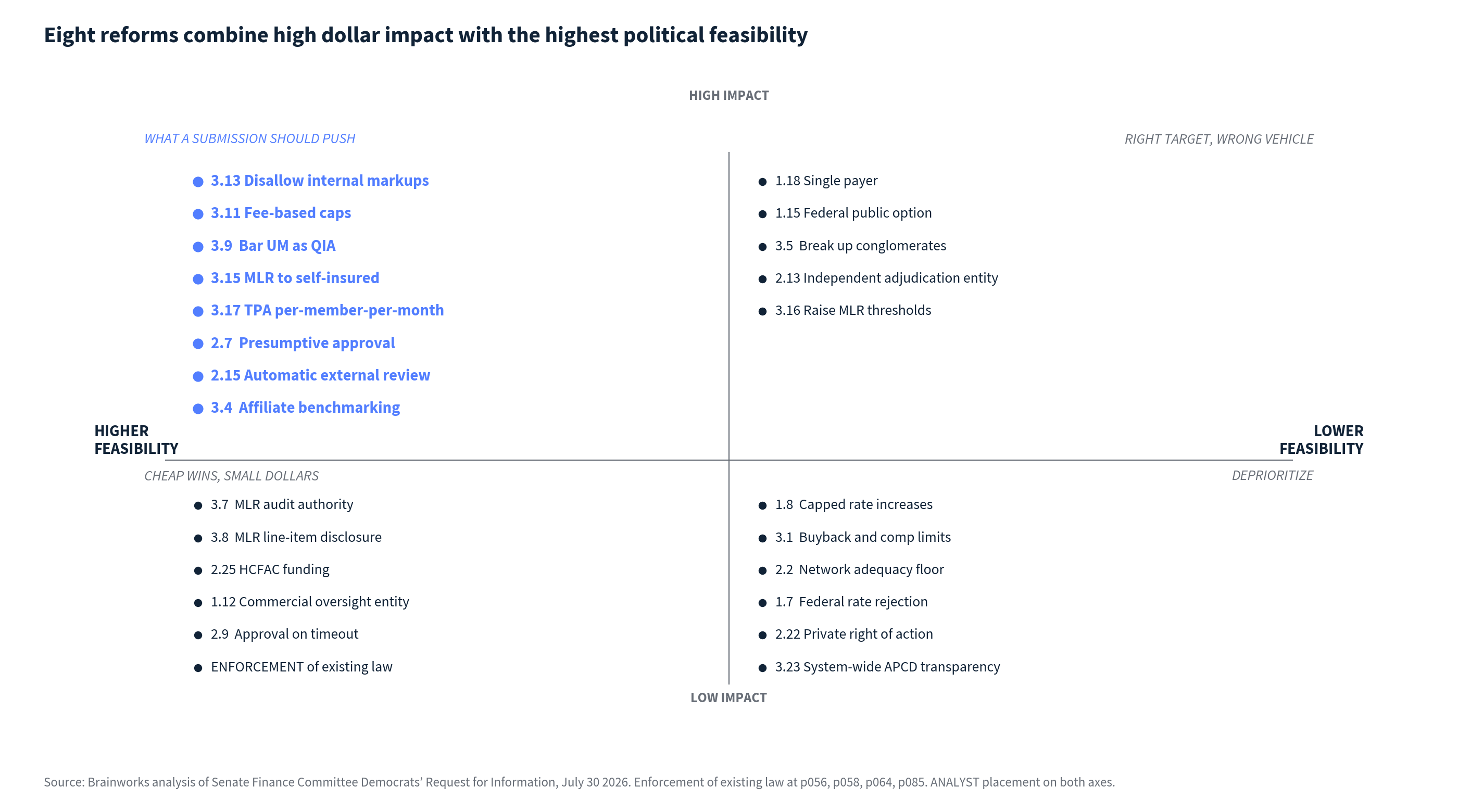
Impact-feasibility quadrants across all 71 rated proposals — what a submission should push, what is the right target in the wrong vehicle, and what to deprioritize.
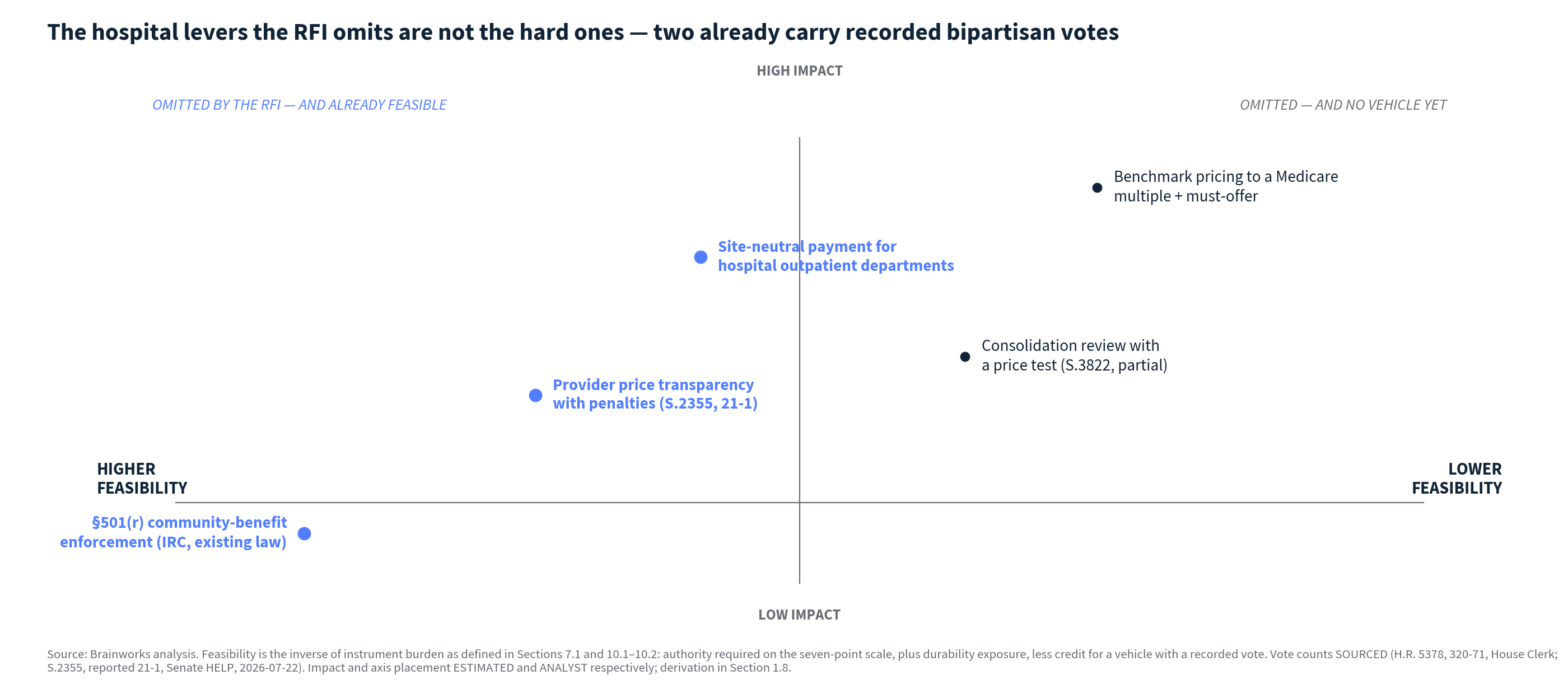
Two of the omitted hospital levers already carry recorded bipartisan votes — site-neutral payment, provider price transparency with penalties (S.2355, 21-1), and §501(r) community-benefit enforcement under existing law.
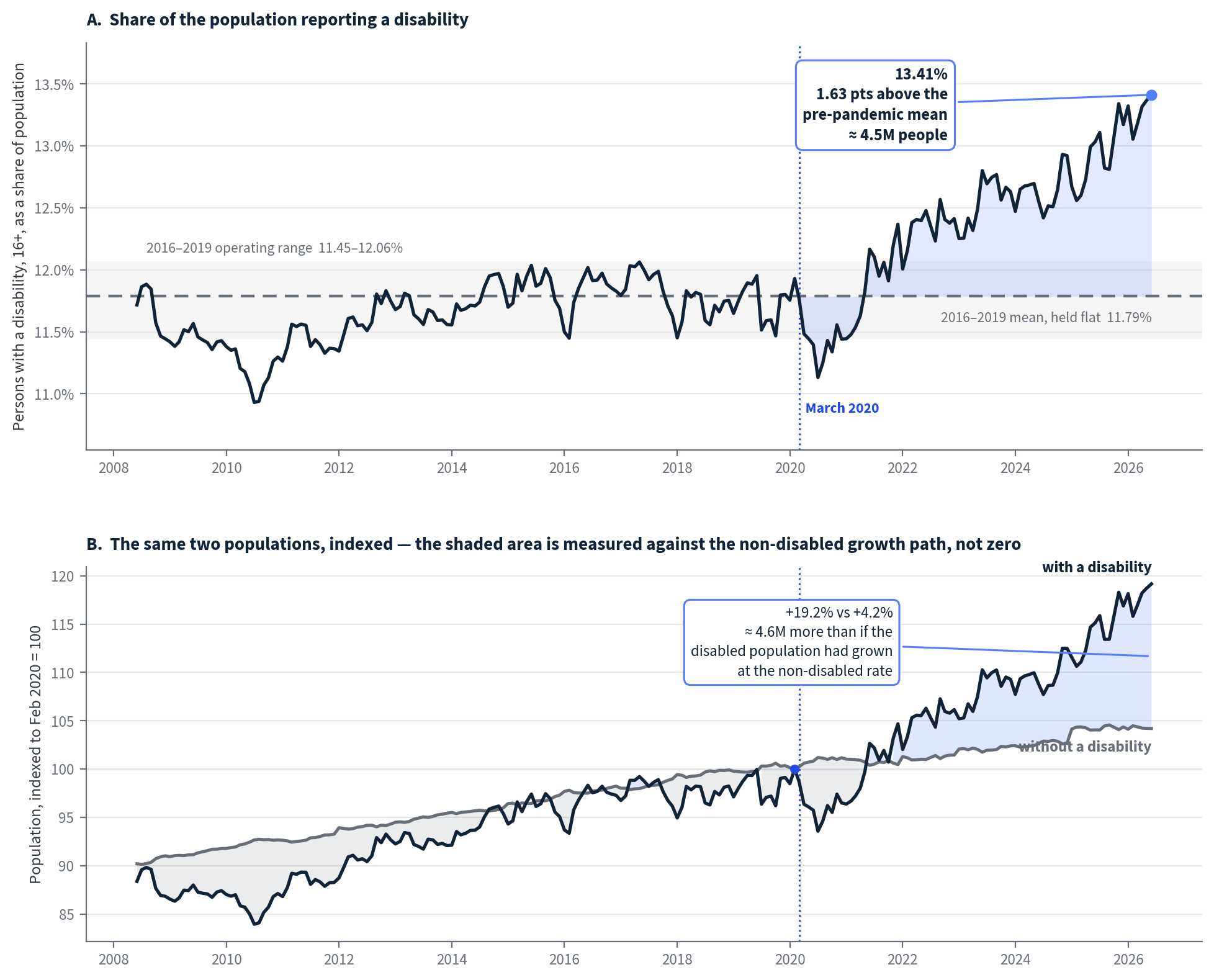
Disability prevalence broke its 2016–2019 operating range in 2021 and never returned — 13.41 percent, 1.63 points above the pre-pandemic mean, roughly 4.5 million people. Chronic illness and long COVID appear nowhere in 86 pages.
Get unlimited access to all 12 chapters, 10 interactive exhibits, and AI analyst conversations.
Or access the current version at fleet.brainworks.ai
Converse with the AI analyst who built this research. Challenge assumptions, explore scenarios, and get personalized insights.
Submission to the Senate Finance Committee on Health Insurance Reform
Get instant, citation-backed insights about this report. Ask anything about the methodology, data, or findings.
Suggested Questions
You have 3 of 3 free queries remaining
Submission to the Senate Finance Committee on Health Insurance Reform
Get instant, citation-backed insights about this report. Ask anything about the methodology, data, or findings.
Suggested Questions
You have 3 of 3 free queries remaining