
5,101 papers → 13 chains → 1 Pearl-defensible therapeutic. The first directed-pair structural map of any mechanistic-disease literature.
This executive summary is available to all readers. Subscribe to access the full report, interactive exhibits, and AI analyst.
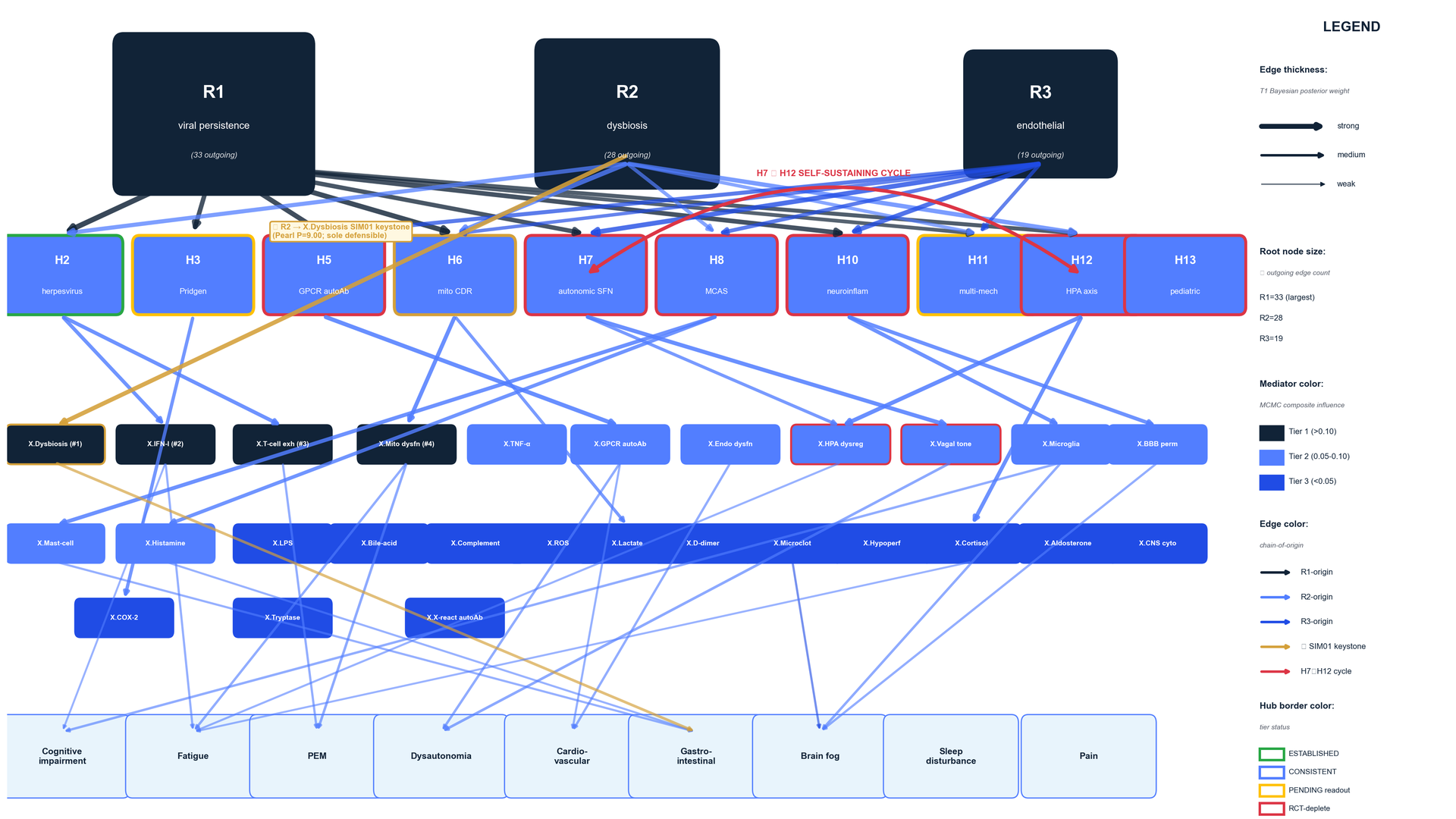
Long COVID affects an estimated 65–200 million people worldwide and has generated a mechanistic literature with more than five thousand peer-reviewed primary papers across more than sixty distinct candidate drivers. The v3.2 atlas applies an eleven-technique analytical stack to 5,101 papers and 222 mechanism link cards to derive a hierarchical-DAG-with-cycles architecture: three causal roots (R1 viral persistence, R2 microbiome dysbiosis, R3 endothelial coagulopathy), ten amplification hubs (H2–H13), and twenty-seven mediators converging onto nine symptom domains. The principal findings include a 156-pair inter-root directed-pair verdict matrix — the first comprehensive structural map of its kind for any mechanistic-disease literature — a dual-version v3.2 / v3.2.1 evidence-tier audit that distinguishes conceptual-coherence curation from strict peer-review evidence grading, a 4-universal-fail field diagnosis showing that four chronic gates (effect-size CI, prospective design, ROBINS-I-passing, PI-independence) fail at field-level frequencies of 59–96% across all 13 chains, the identification of SIM01 → X.Dysbiosis as the sole Pearl-defensible therapeutic claim (composite priority score 9.00 vs runner-up 1.96), and a seven-item v3.3 RCT priority queue ranked by composite-influence weight. The atlas resolves the four-year theoretical dispute between the Groysman 2024 flat-network frame and the Proal–VanElzakker 2021 triadic-root frame by absorbing both as projections of the hierarchical-DAG-with-cycles architecture.
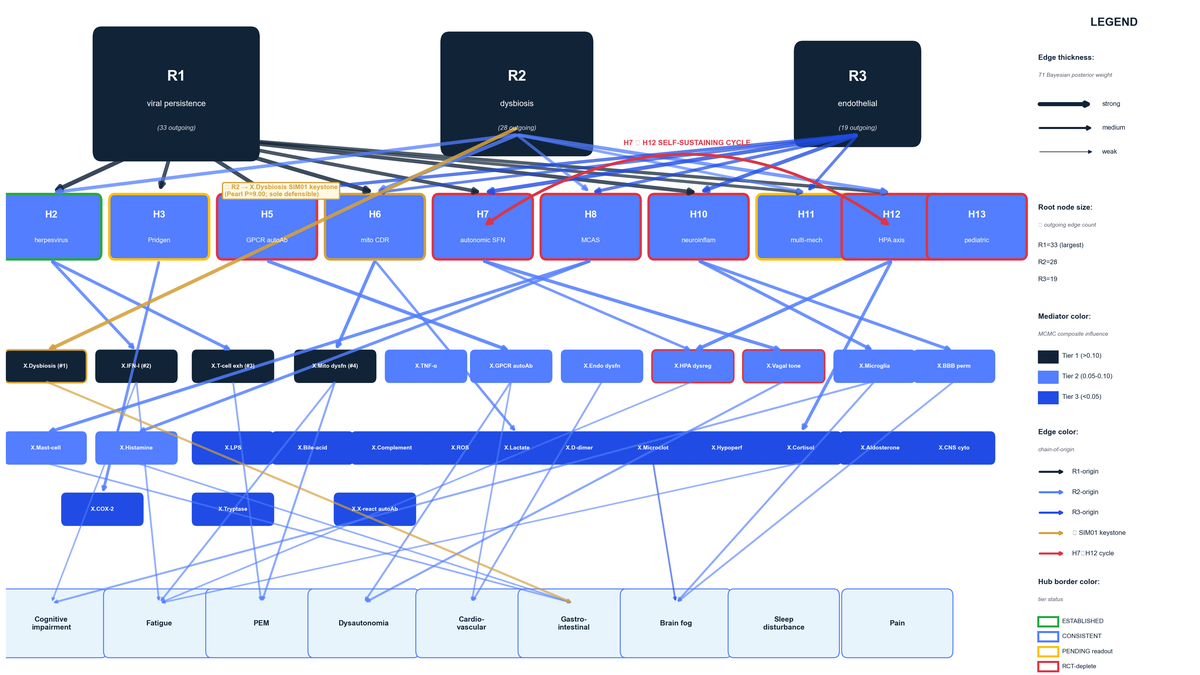
Capstone architectural visualization — all 13 chains with relative directional-support strength (edge thickness = T1 Bayesian posterior weight). Four-row DAG: 3 roots → 10 hubs → 27 mediators → 9 symptom domains.
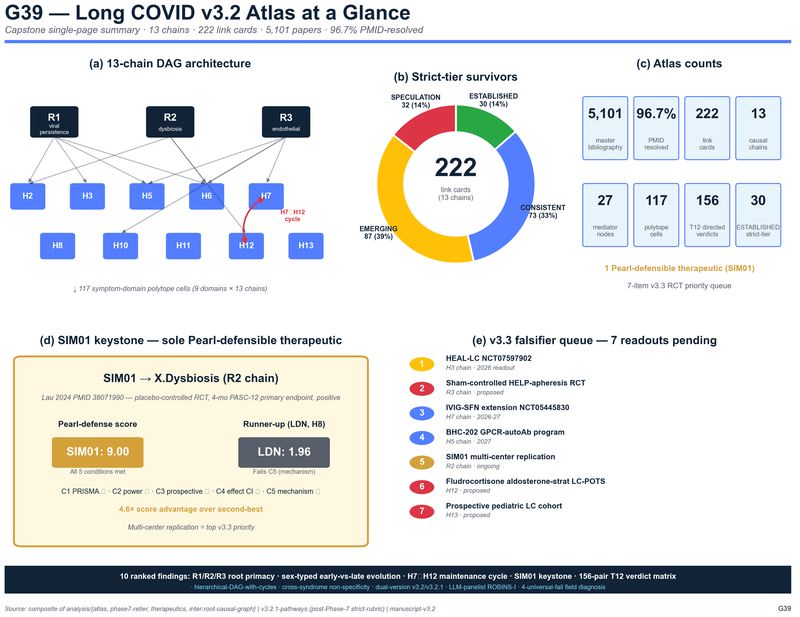
Single-page summary distilling 5,101 papers into 13 chains, 30 ESTABLISHED-tier mechanisms, 4 SPOFs, 4 RCT-deplete chains, and 1 Pearl-defensible therapeutic.
The 4-universal-fail pattern (C4=96%, C3=81%, C7=73%, C6=59%) is invariant across all 13 chains — evidence that the chronic gates are field-level structural deficiencies, not chain-specific artifacts.
Get unlimited access to all 16 chapters, 43 interactive exhibits, and AI analyst conversations.
Or access the current version at fleet.brainworks.ai
Converse with the AI analyst who built this research. Challenge assumptions, explore scenarios, and get personalized insights.
Long COVID Mechanistic Pathway Atlas v3.2
Get instant, citation-backed insights about this report. Ask anything about the methodology, data, or findings.
Suggested Questions
You have 3 of 3 free queries remaining
Long COVID Mechanistic Pathway Atlas v3.2
Get instant, citation-backed insights about this report. Ask anything about the methodology, data, or findings.
Suggested Questions
You have 3 of 3 free queries remaining